Read the group before you chase the score
Understand group centre, spread, trace coverage and timing, then choose one testable next step.
Key takeaways
- Read group location and spread together; a total score alone hides both.
- Compare equal-sized series under similar conditions and check missing data.
- Use an observation to choose a test, rather than diagnosing technique from direction.
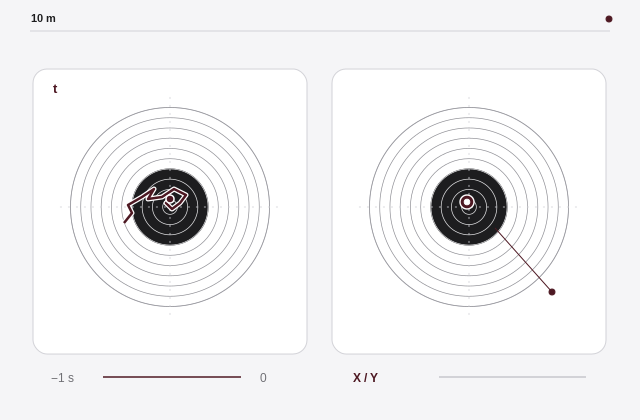
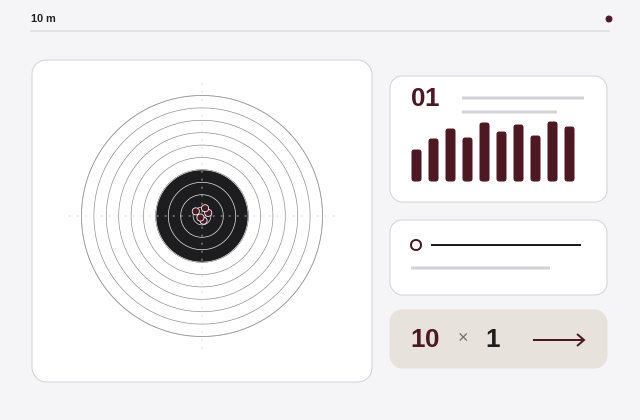
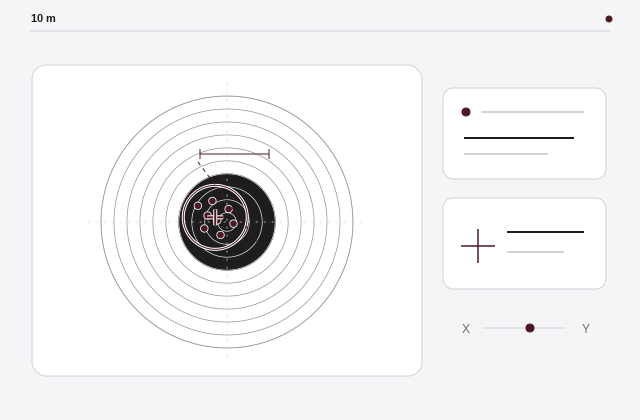
A total score is a convenient result, but it compresses many different shot patterns into one number. The target plot shows where the group sits and how widely the shots spread. The shot list, trace and timing add context. Read them together before deciding what to change in the next session.
Begin with the measurement conditions
Check the session mode, camera setup and calibration note. Ask whether the target or camera moved, whether a fresh target was fitted and whether any events needed manual confirmation. A shift caused by remounting the target should be investigated as a setup change before you interpret it as a technique change.
Separate group centre from group spread
The mean point of impact is the average of the recorded shot coordinates. It describes the group’s location relative to the target centre. Extreme spread is the greatest distance between any two recorded positions. Mean radius is the average distance of the positions from their own group centre. The latter describes dispersion around the group, rather than its distance from the bull.
These measures answer different questions. A compact group away from the centre has a location issue to investigate; a widely dispersed group centred on average can still contain many distant shots. An outlying shot can move the mean and increase the extreme spread considerably. Check the plot and event record before attributing a numerical change to a single cause.
Compare series fairly
- Start with series containing the same number of recorded shots.
- Keep registration source, calibration and target arrangement comparable.
- Read the integer or decimal total consistently across the comparison.
- Mark a partial series as partial rather than ranking it against a complete series.
- Retain unusual shots and explain any recording problem in your note.
Larger groups have more opportunities to contain a distant pair, so a full-session extreme spread is not directly equivalent to a shorter series. Comparing complete ten-shot series is a useful starting point. The report’s best-series comparison uses complete series with recorded scores; a short unfinished series should not become best simply because it contains fewer shots.
Check what the timing and trace actually observed
Recorded shot intervals and elapsed time can help you describe rhythm, but they are not a complete account of your preparation or hold. Missing intervals remain missing. Pausing the session changes the relationship between active practice time and the clock on the wall, so keep breaks in your journal when comparing sessions.
Select a shot to inspect its available trace. Before comparing steadiness, check that both traces cover the relevant part of the event. A value based on only one point or absent movement data cannot establish a steadier hold. Registration confidence describes the measurement and is not a rating of the quality of your technique.
Turn an observation into a next-session question
Use neutral descriptions: the second complete series had a wider group; the group centre moved after a target change; or the later shots had longer recorded intervals. Then choose one test, such as checking the mapping after remounting, repeating the same routine for another short series, or discussing a repeated pattern with your coach. The plot supplies evidence, not a diagnosis of a grip or trigger fault.
Your saved sessions remain associated with your account. Download a report when you want a durable copy for your journal or to share with someone you choose. Keep the session date and source beside the plot so it remains interpretable later.
Create a short journal that connects the review to your next session
Take it to your next session.
Put one idea into practice, then use your saved shots and notes to see what changed.